
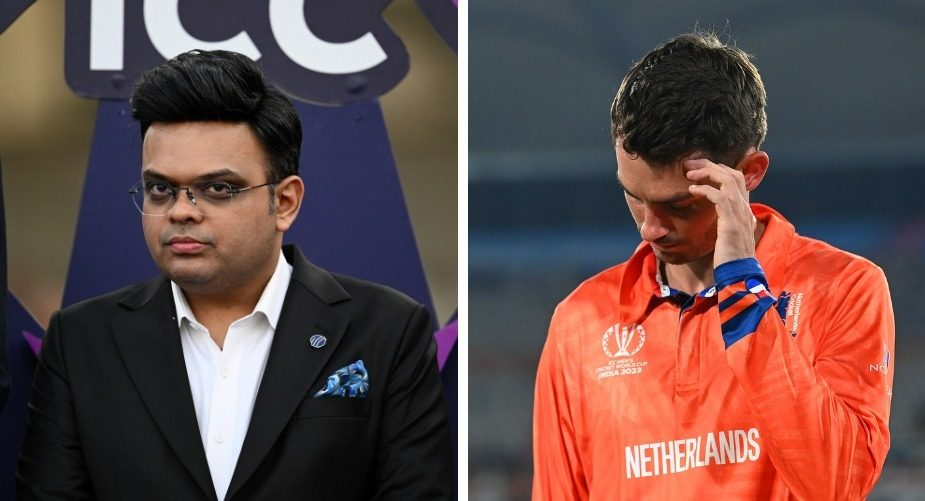
The proposed changes to the format will see the competition start with a three-team Super Series, from which only the winner will advance to the group stage-proper. In the most likely scenario, at least two out of the three teams in that Super Series will be Associates, meaning there’s a high chance that no Associate country will feature past that stage of the tournament.
This week, Cricket Scotland and the Dutch Cricket Association (KNCB) issued a strongly-worded joint statement opposing the changes. “These changes represent a setback to Associate Member cricket and risk undermining the progress made in recent years to grow the global game,” read the statement. “At a time where cricket is seeking to expand its reach, attract new audiences and strengthen its position on the international sporting landscape, reducing meaningful opportunities for emerging nations sends entirely the wrong message.”
The tone of the statement was visceral. In 2021, the ICC announced that the 2027 men’s 50-over World Cup would be expanded to 14 teams. The 2019 and 2023 tournaments were both limited to 10 teams, meaning that at least two Full Members were excluded from both tournaments, let alone Associates. The 2027 tournament represented the first real opportunity in 12 years for Associate sides to participate in a men’s 50-over World Cup. The last time the World Cup included 14 nations, in 2015, it was played as two groups of seven before the top four from each qualified for quarter-finals.
Cricket Scotland and the Netherlands Cricket Board have expressed disappointment over the ICC's decision to revamp the structure of the Men's ODI World Cup 2027.#Cricket #WorldCup pic.twitter.com/KUHTV7D8Lv
— Wisden (@WisdenCricket) August 11, 2026
It would be reasonable for Cricket Scotland and the Netherlands to assume the 2027 edition would follow a similar structure. Instead, the introduction of the Super Series tier to the tournament represents a third qualification hurdle, after both sides secured places in the Global Qualifier from their position in Cricket World Cup League Two.
“Members and their players invest years in preparing for World Cups and confidence in those pathways depends on them not changing part-way through a qualification cycle without consultation,” read the statement from Cricket Scotland and the KNCB. “Changing those structures at short notice creates significant uncertainty, disrupts planning, and places additional operational and financial pressure on organisations that are already operating with limited resources.”
There’s an irony in that the decision to change the format was made at the ICC’s General Meeting last month in Edinburgh. Cricket Scotland’s representatives were presumably not in the room when the decision was made. The three current Associate governing bodies on the ICC Chief executive committee in rotation are France, UAE and Namibia. Having invited the ICC in, Cricket Scotland were then seemingly left blindsided by the decision to likely exclude them from the majority of next year’s World Cup.
Participating at ICC events for Associate Nations is hardly symbolic, it can be a lifeline. Cricket Scotland receives approximately £2.7 million from the ICC under the current revenue description model, while the KNCB runs its entire operation on around $6 million per year. Of the other top performing tier of Associate boards, both Cricket USA and Cricket Canada have been suspended by the ICC in the last 12 months after corruption allegations and bankruptcy proceedings, while Nepal have been promised to host an India A series as a financial carrot from the BCCI.
Scotland’s participation in the 2026 T20 World Cup, which they entered at the last minute when Bangladesh pulled out, could boost their 2026 revenues by around $1 million. Equally, participating on a global stage is an opportunity to attract commercial partners and boost interest at home. Failure to qualify, or being excluded from the opportunity to participate, can have huge ramifications.
Is this the strangest World Cup format we've ever seen? 🤯
🎥 @kshitij_cricket pic.twitter.com/YBw7fN3H0I
Thailand Women bore the brunt of those consequences during the 2021 Women’s World Cup Qualifier. Having won three out of their four group matches, Thailand were in prime position to qualify for the women’s 50-over World Cup for the first time, on a roll after participating in the 2020 T20 World Cup. However, the tournament was called-off midway through due to the Covid-19 pandemic, and the ICC subsequently decided to allocate the three final positions at the tournament based on the global rankings. That meant Bangladesh, who Thailand had already beaten in the Qualifier, went through, while Thailand didn’t.
Cruelly, Thailand had not had the chance to boost their standing on the global rankings in the tournament, as the ICC had previously reversed its stance on Qualifier matches being given full ODI status. Some estimates say that decision set women’s cricket back in Thailand by three years. They haven’t qualified for another major tournament since.
Another example of the ICC riding rough-shot over Associate advancement was when they expanded the women’s Cricket World Cup League to 11 teams for the current edition. They added Zimbabwe, over Scotland and Papua New Guinea, both of whom sit above Zimbabwe in the global rankings. That decision means that Zimbabwe will play bilateral series against every top-tier women’s side over the next four years, while Scotland have nothing in the calendar outside of qualifier tournaments.
The ICC’s charter states that one of its objectives is to “develop cricket at all levels throughout the world”. It also pledges to “to ensure the sporting calendar for cricket is organised and scheduled in accordance with the best long-term interests of the sport as a whole”. It’s explicitly clear from their continued handling of Associates that the ICC has a narrow view of that particular responsibility. Their approach looks closer to dangling financial carrots just out of reach, watching them jump through ever contracting hoops.
As the plea from Cricket Scotland and the KNCB concluded: “Cricket’s future is strongest when every Member has a genuine and fair opportunity to compete, develop and succeed.”
Follow Wisden for all cricket updates, including live scores, match stats, quizzes and more. Stay up to date with the latest cricket news, player updates, team standings, match highlights, video analysis and live match odds.
Leave a Comment